



Home
/
Blog
/ NECKSTRAPS
/ LEICA M
/ LEICA Q
/ LEICA SL & S
/ Nile Crocodile vs. American Alligator...
An honest look from the cutting table at Nile Crocodile and American Alligator leather. From natural scale geometry to the high-stakes precision of cutting a complete camera half-case with zero room for error.
When clients ask me about the difference between Nile Crocodile and American Alligator, they are usually looking for a justification of price or prestige. But on the workshop bench, the distinction isn't about status—it is about geometry, anatomy, and how the leather responds to the knife and the needle.
From a biological standpoint, these two apex predators belong to entirely different families: the American Alligator (Alligator mississippiensis), native to the freshwater marshes of the southeastern United States, and the Nile Crocodile (Crocodylus niloticus), thriving in the rivers and lakes of Africa.
In our Italian workshop, working with these exotic skins requires a complete shift in mindset compared to traditional calf or horse hide. Here is what really sets them apart when you look at them up close.
The Visual Clues: Pores vs. Scars
You don't need a certificate to tell these skins apart; nature left clear signatures on both.
-
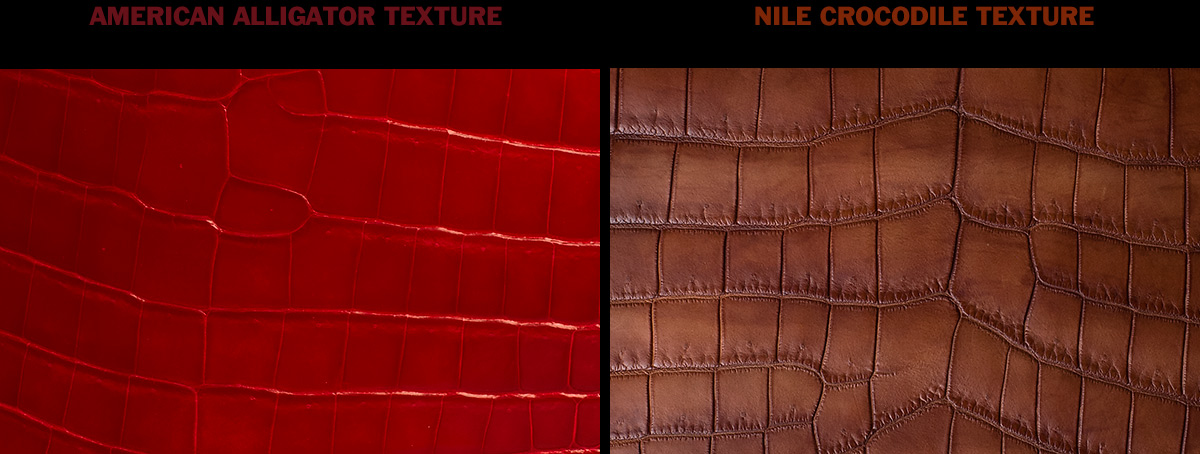
The Alligator's Clean Slate: If you run your fingers over an alligator belly, the scales are completely smooth. Alligators only have sensory organs on their faces. The defining feature here is the umbilical scar—a small, elongated star pattern on the belly. In high-end watch straps or camera cases, placing this scar dead center is how an artisan shows the cut was intentional and premium.
-
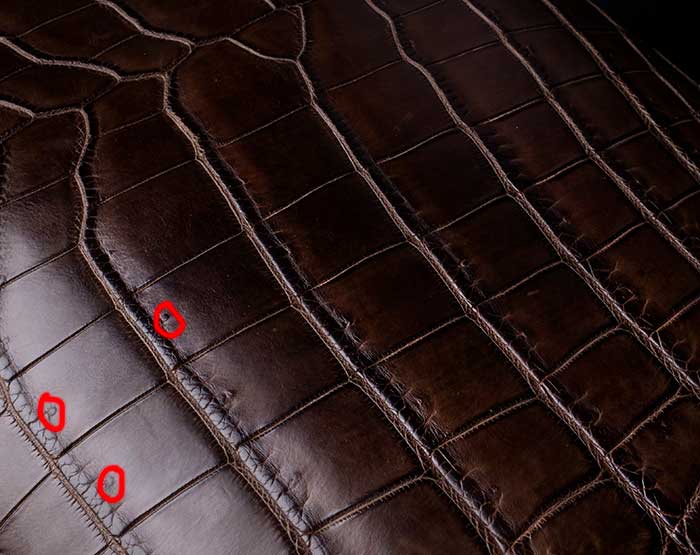
The Crocodile’s Pore: Nile Crocodile (Crocodylus niloticus) carries a tiny, microscopic pit near the edge of every single scale. These are the remnants of sensory pores used to detect water vibrations. If you see that tiny dot, it’s a crocodile (in photo here).
Geometry and Symmetry
Alligator scales are slightly more organic and irregular. They transition quickly from squares on the belly to small, rounded circles on the flanks. Nile Crocodile, on the other hand, is famous for its architectural symmetry. The square tiles are remarkably uniform across the entire belly, which is ideal if you are looking for a perfectly balanced, geometric look.
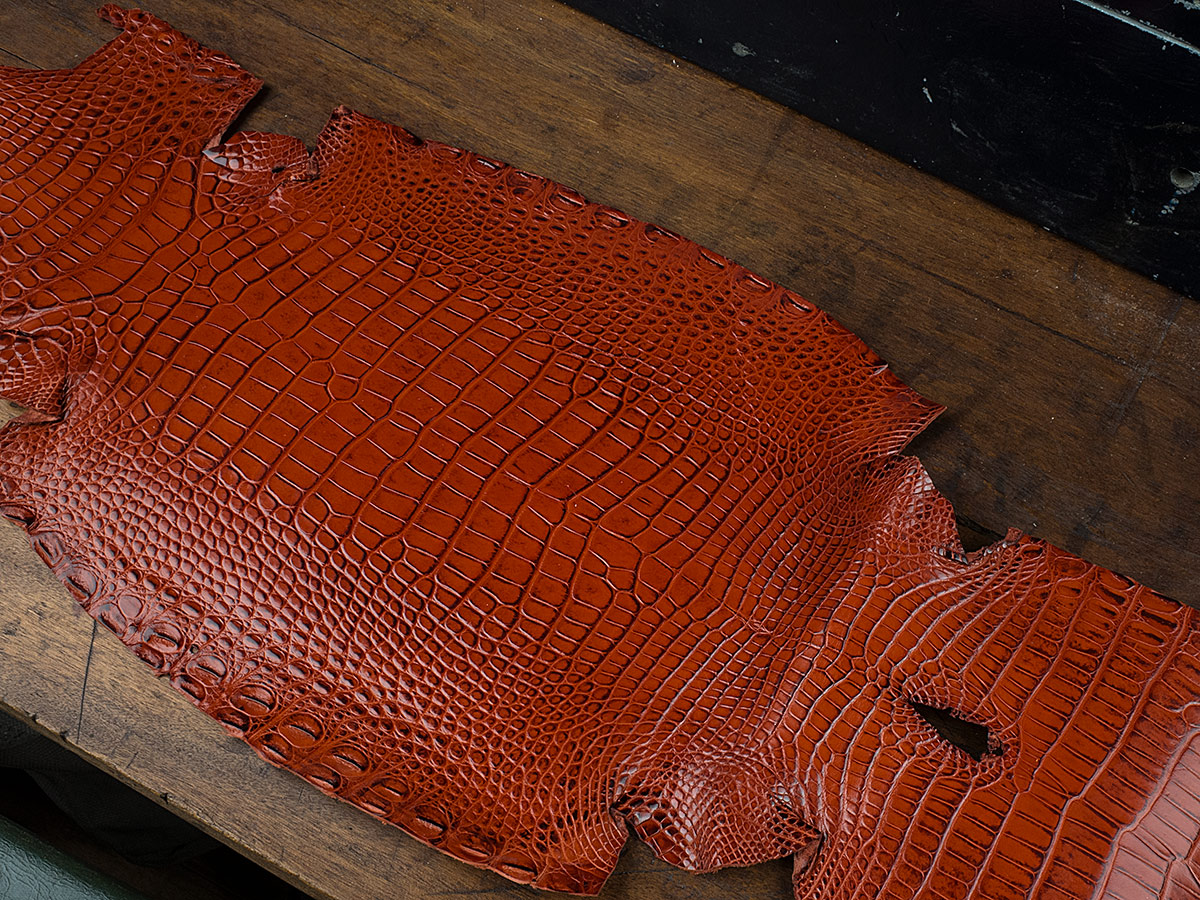
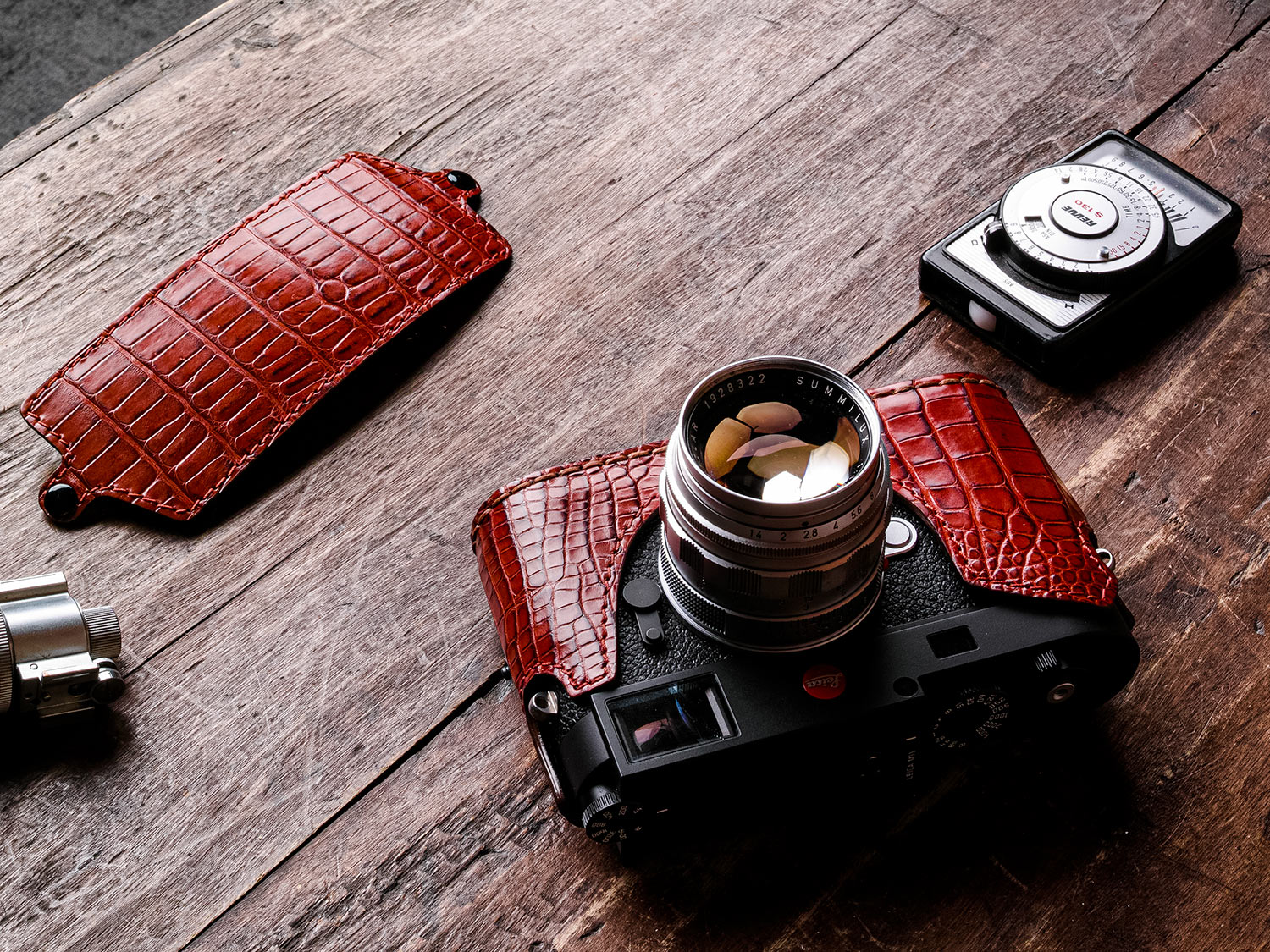
(in photo an alligator in orange color, a beautiful and very clean pattern) before and the final result
On the Bench: How They Work and Age
The biology of the animal dictates how the skin behaves during the tanning process here in Tuscany, and ultimately, how it wears in your hands.
Flexibility vs. Structure
Alligator has a more relaxed fiber structure. It is naturally pliable, making it easier to wrap around the sharp, compound curves of a camera half-case or the tight edges of a strap.
Nile Crocodile is denser. The collagen matrix is tightly packed, making the leather stiffer and more rigid out of the tannery. It demands more effort to mold, but the payoff is incredible structural durability. It holds its shape stubbornly over time.
Alligator darkens and softens quickly, turning friction and use into a warm, organic glow. Crocodile resists changing too fast. It keeps its sharp lines, and instead of softening completely, the surface of the scales burnishes into a hard, glossy shield. The tiny sensory pores catch subtle highlights over the years, giving the skin a distinct three-dimensional depth.
The Pressure at the Cutting Table: Zero Room for Error
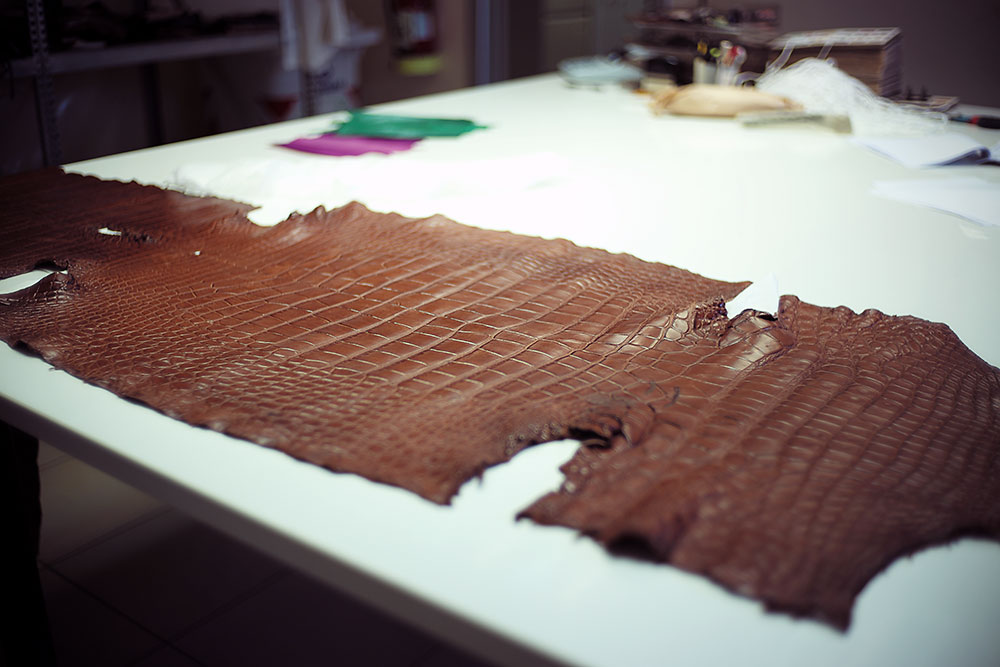
Working with these exotics is completely different from cutting a standard calf or horse hide. With regular leather, you have a large, relatively uniform surface. With alligator and crocodile, you are dealing with a naturally irregular, non-geometric shape that tapers dynamically from the throat down to the tail.
When the goal is to craft a complete camera half-case, the difficulty climbs exponentially.
The Geometry of a Mistake
A camera case isn't a flat wallet; it is a three-dimensional object with sharp corners, battery door cutouts, and tight grip curves. To make it look right, the scale pattern must flow seamlessly around the camera body. You cannot just place the acrylic pattern anywhere on the skin. You have to hunt for the perfect symmetry, aligning the central spine of the scales with the exact axis of the camera.
Because the skin narrows and changes texture constantly, finding a single, unblemished section large enough to cut a full half-case—without breaking the visual harmony of the tiles—is incredibly rare.
The Cost of a Millimeter
On the cutting table, the pressure is absolute. You are working with a knife on a material that costs hundreds of euros per skin.
-
No Correcting: If the blade slips by a single millimeter, or if you miscalculate how the scales will distort when molded around the camera's grip, the entire cut is ruined.
-
The Waste: You cannot patch exotic leather. A mismatched scale pattern or a misaligned cut means the piece is useless for a premium project. There is no backing up; you either get it perfectly right on the first pass, or you throw the entire section into the scrap bin.
Final Thoughts & The Workshop Care Guide
Choosing between Nile Crocodile and American Alligator isn’t about finding a "better" leather—it is about choosing how you want your accessory to live alongside you. One offers structural, geometric permanence; the other offers a soft, organic adaptation to your grip.
But regardless of which hide rolls off the cutting table, exotic leathers require respect. They are incredibly durable, but they are not indestructible.
Here is the straightforward, no-nonsense care routine we recommend in the workshop to keep these skins pristine for decades.
1. The Golden Rule: Keep It Dry
Exotic skins are highly sensitive to moisture. Unlike standard calfskin, excess water can cause the natural proteins in crocodile and alligator scales to swell, lift, or permanently lose their finish.
-
If you get caught in the rain while shooting, do not panic and do not use a hairdryer.
-
Immediately blot the leather gently with a clean, dry microfiber cloth and let it air-dry naturally at room temperature, away from direct heat sources.
2. Cleaning and Dusting
Dust and grit love to settle into the grooves (the valleys) between the scales. Over time, friction from this trapped grit can wear down the finish.
-
Once every few weeks, take a dry, incredibly soft-bristled brush or a lint-free cloth and gently wipe along the direction of the scales.
-
Never use generic leather cleaners, saddle soaps, or solvents. They are far too aggressive for the delicate finish of an exotic hide and will strip away its natural oils.
3. Conditioning (Less is More)
Exotic skins do not need frequent conditioning. Over-conditioning will clog the fibers, ruin the hand-feel, and can turn a beautiful matte finish into a cloudy, sticky mess.
-
Only condition the leather once or twice a year, or if it feels distinctly dry to the touch.
-
Use a premium, specialized exotic leather cream (specifically formulated for reptile skins). These are lighter and designed to penetrate the dense scale structure without leaving a heavy residue (you can ask us if you want some advice)
-
Apply a tiny, pea-sized amount to a cloth—never directly to the skin—and buff gently in the direction of the scales.
4. Storage
When you aren’t using your camera or accessory, store it in a cool, dry place inside its original cotton dust bag. Avoid plastic bags, which trap humidity and can cause mold, and keep it out of prolonged, direct sunlight to prevent the deep dyes from fading prematurely.
With these simple habits, the high-stakes precision that began at our cutting table will endure for a lifetime in your hands, developing a story that belongs entirely to you.
Related Products
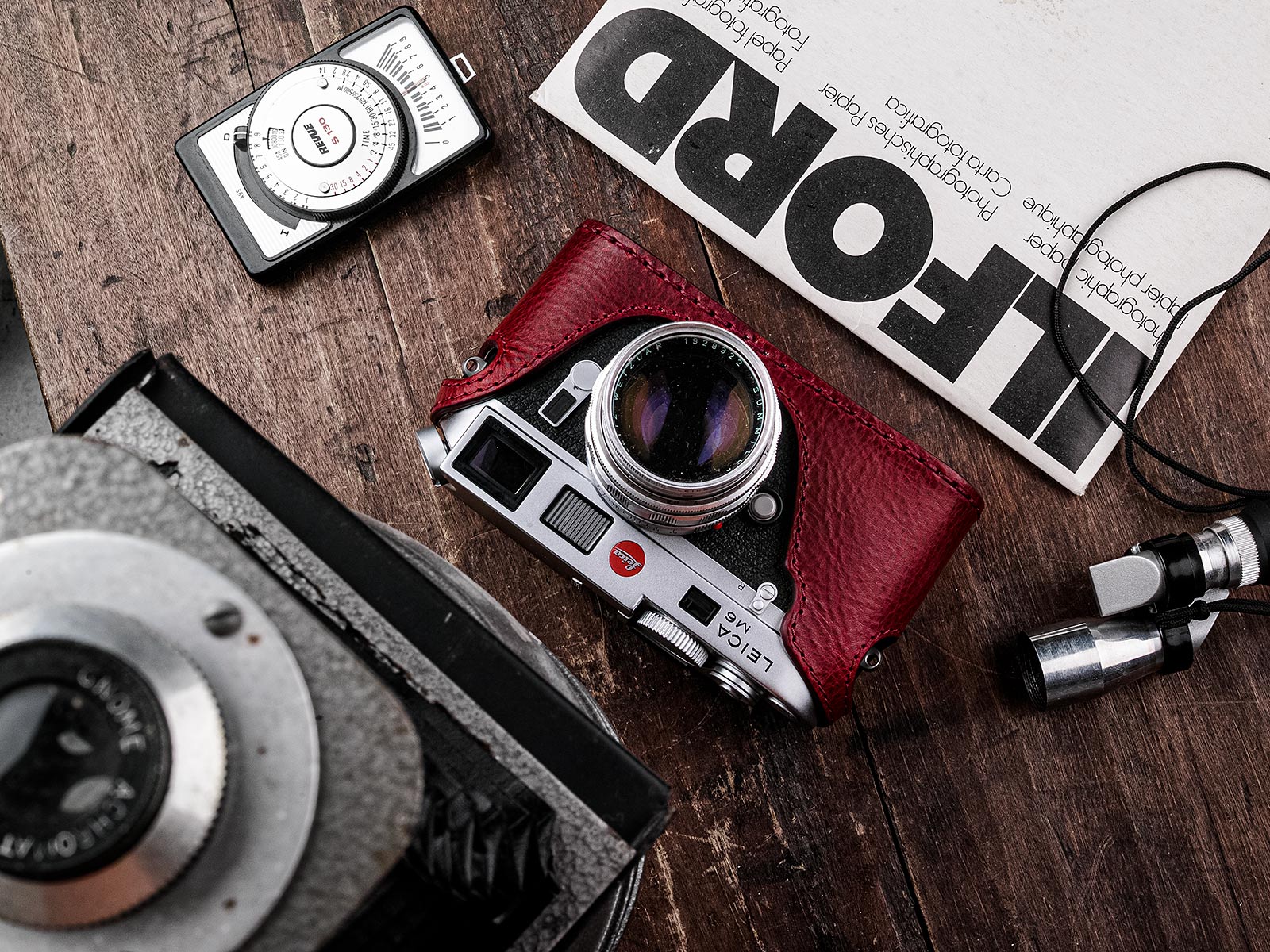
LEICA M2 M3 M4 M6 M7 M-P M-A (typ 127)
SKU: CASE_M_FILM249,00
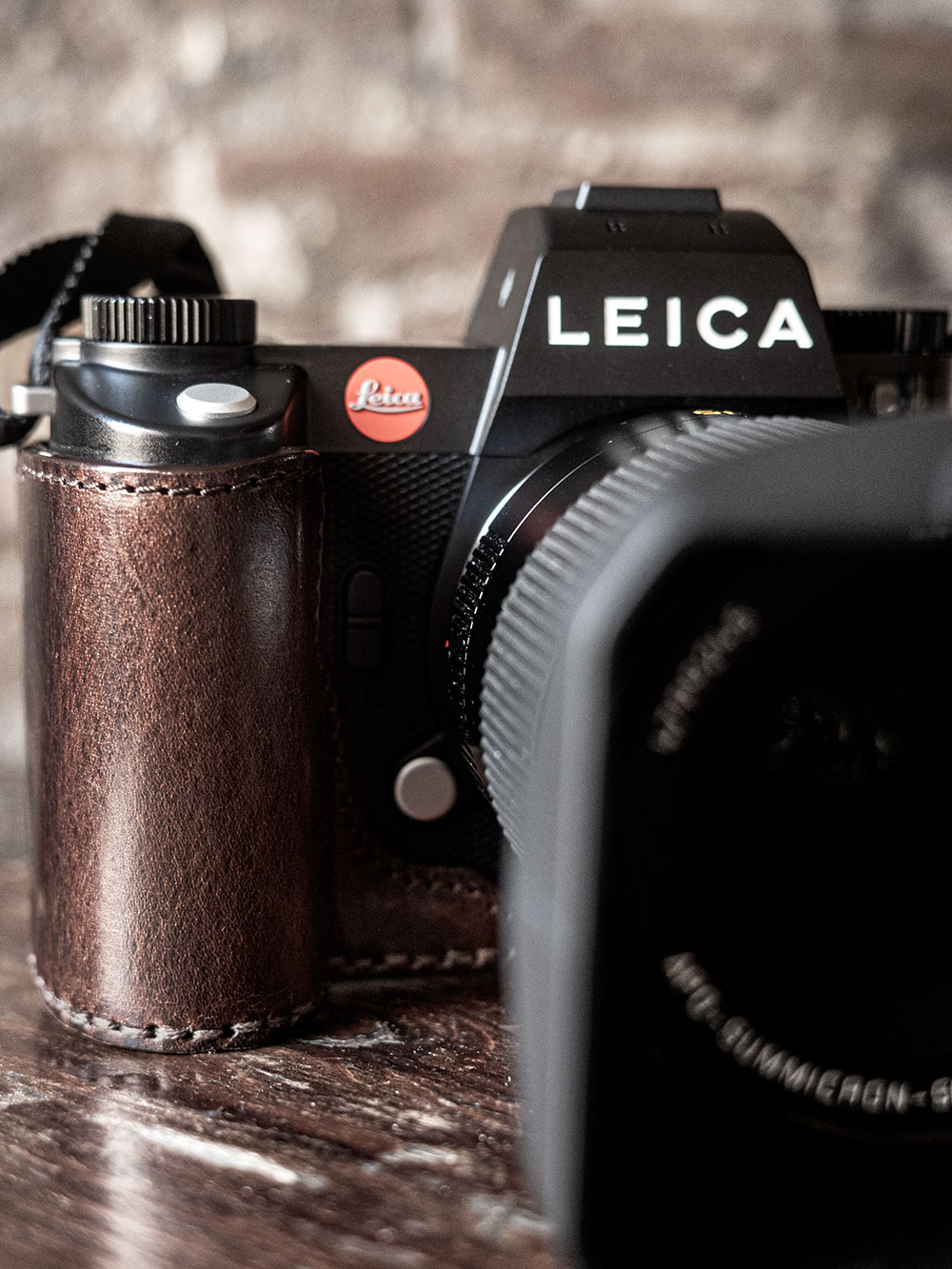
LEICA SL3 & SL3-S CASE
SKU: CASE_SL3299,90
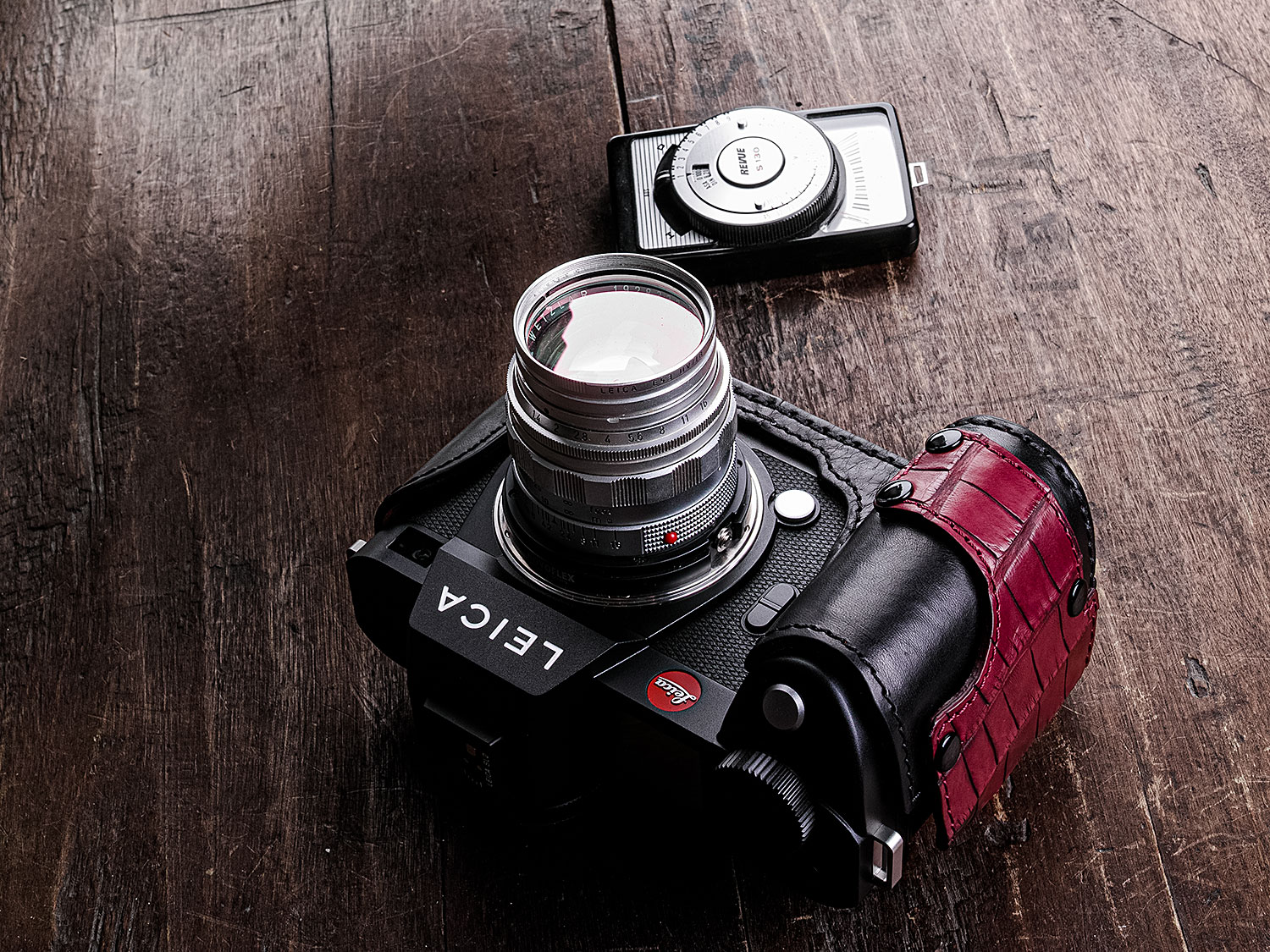
LEICA SL3 & SL3-S OPEN CASE
SKU: CASE_SL3_OPEN339,90
LEICA M11 & M EV1 CASE
SKU: M11_2024299,90
Leica M11-D case
SKU: M11D_HERITAGE299,00
LEICA Q3 HALF CASE
SKU: Q3_CASE259,00
Topics
More Articles
-
"Our products are made in very limited run. It means that you are one of the few in the world to have our leathercraft."
Angelo Smaldore, Founder
-
Contact
info@angelo-pelle.com via del tiglio 120, Saludecio RN (Italy) P.IVA 04032120406